Case study — 01 / 06
Public Signals into Actionable Intelligence
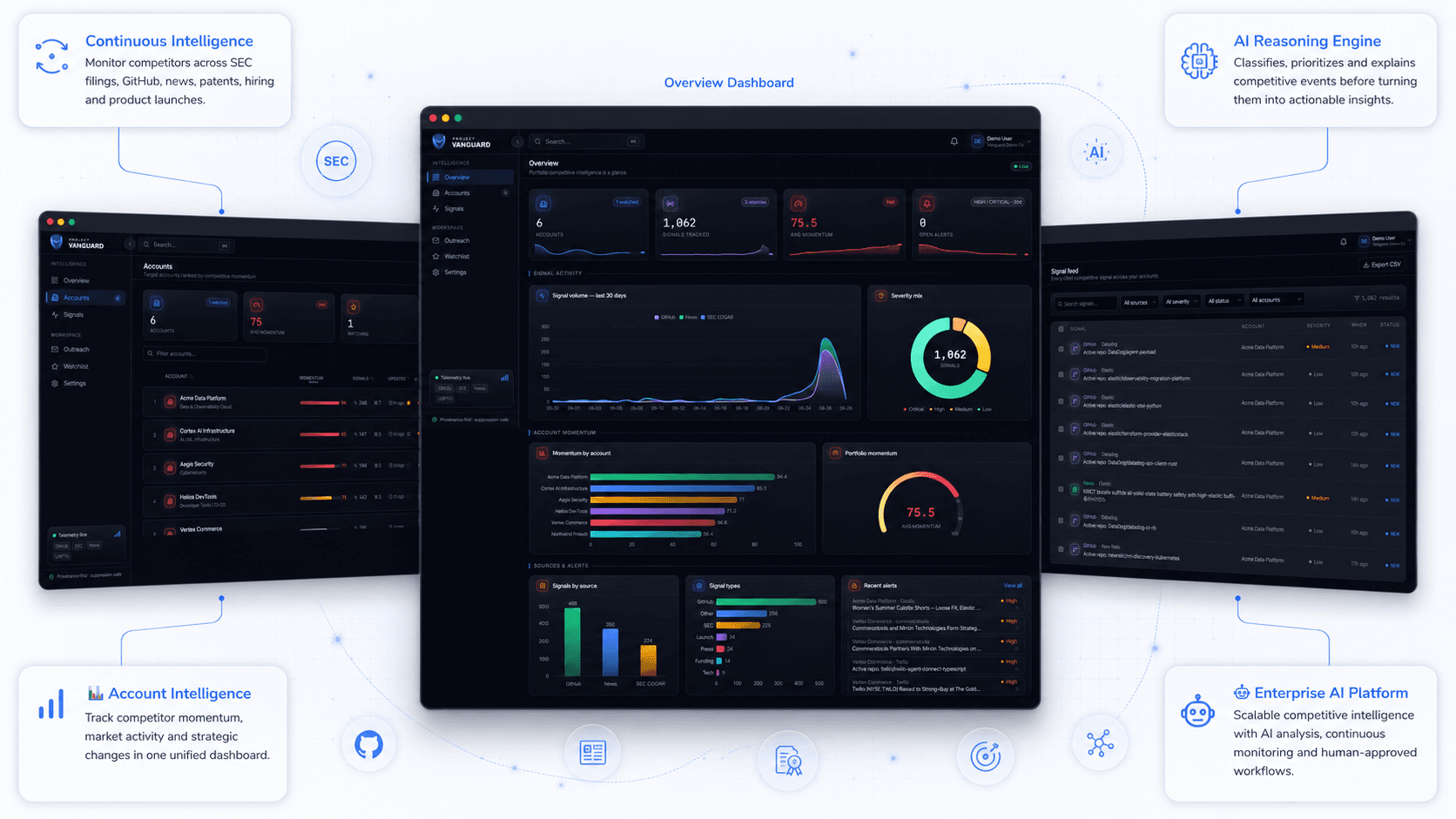
Project Vanguard is a personal, self-directed project I built in my free time to learn by solving a real problem — not a product or a startup, but an exercise in how AI, public data, and modern full-stack architecture fit together. It continuously monitors the public moves of a target account's competitors across SEC EDGAR, GitHub, Google News, patents, and hiring pages, then uses an LLM to classify, rank, and explain the handful of signals that actually matter — every one traceable back to its original public source. The most valuable part wasn't the features; it was deciding where AI genuinely adds value versus where deterministic logic is the safer, more honest choice.




Product Showcase
The screens
What it does
Key features
01
Multi-Source Signal Monitoring
Reads public competitor activity in parallel across SEC EDGAR filings, GitHub, Google News, USPTO patents, and hiring boards — each signal keeping its original source URL and verbatim excerpt.
02
AI Reasoning & Classification
A Gemini-powered step judges every event for type, severity, and relevance, filtering routine noise so only meaningful competitive moves surface.
03
Provenance-First Signals
Every signal links to its public source and the exact excerpt it came from — the AI classifies real evidence and never asserts a fact that isn't in the source.
04
Account Momentum Scoring
A transparent score — severity × relevance × recency × corroboration — ranks which accounts are under the most competitive heat and trends it over time.
05
Signal → Solution Matching
A two-step LLM and embedding flow translates a raw signal into a business problem, then matches it to the right talking point instead of naive keyword matching.
06
Human-in-the-Loop Outreach
Drafts cited, role-aware outreach — draft-only by design, with an enforced suppression list and a human approval step before anything is ever sent.
The hard parts
Deciding where AI genuinely adds value versus where deterministic logic is safer, matching noisy signals to the right response across a semantic gap, and staying resilient against public-API rate limits with throttling, caching, and content-hash deduplication — all while keeping every AI output traceable to a real public source.
The outcome
An end-to-end learning build: a multi-tenant, nightly-monitored pipeline that compresses a firehose of public data into a short list of cited, ranked, explained signals. More than the code, it was a lesson in AI architecture, provenance, and restraint — showing less rather than fabricating when the data simply isn't there.
Next case
LearnVerseA Universe of Ideas, One Platform